
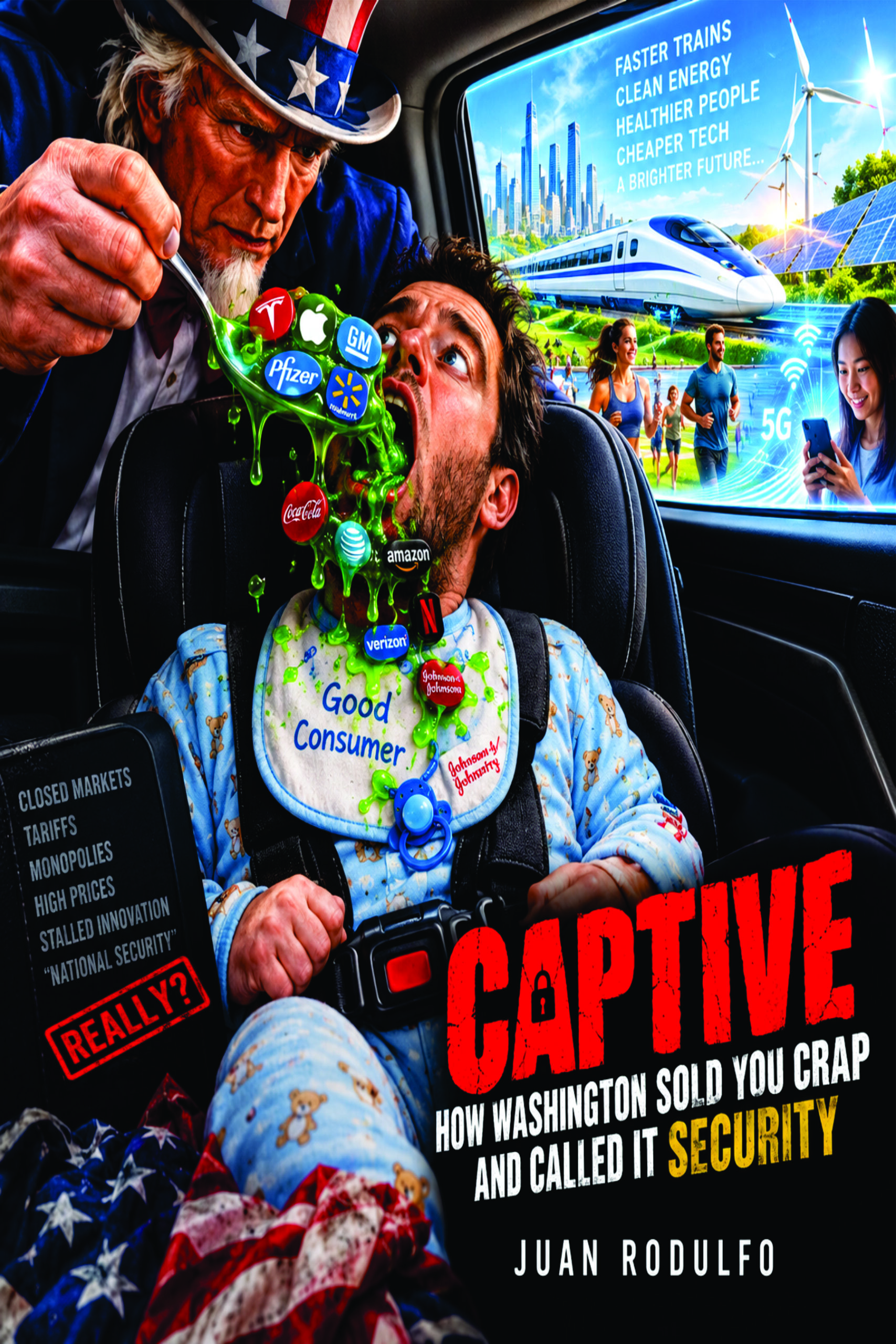



CAPTIVE: How Washington Sold You Crap and Called It Security
Price range: $1.99 through $28.99
Description

$10,000 buys a brand-new BYD Seagull in Shanghai: a road-legal electric hatchback with the fit and finish of cars priced above $35,000 in America. In America, you cannot buy it at any price. Washington has stacked a 100 percent tariff on top of a 2.5 percent baseline duty, then added a connected-vehicle rule that bans its software outright. Officially, national security. The real reason is arithmetic, and the beneficiaries are nameable.
CAPTIVE is the receipt trail. Juan Rodulfo follows the same architecture through four closed markets: the car you cannot buy, the phone that was blacklisted, the insulin that sells for more than nine times its price in comparable countries, and the broadband pipe compromised through the backdoor the government ordered carriers to build. He shows how tariffs, blacklists, patent thickets, and dealer-franchise laws form one system of regulatory capture: a cartel enforced by law and marketed as protection.
Then he tests the security claim against the government’s own record. Equifax lost the data of 147 million Americans through an unpatched server. OPM lost 22.1 million security-clearance files from an unencrypted database. SolarWinds let Russian intelligence into nine federal agencies for nine months. Salt Typhoon walked in through CALEA’s lawful-intercept backdoor. A Secretary of Defense shared strike details in a chat with his wife. The institutions that cannot secure their own networks have appointed themselves the gatekeepers of your market.
Inside, you will find:
- The five-layer tariff wall that keeps cheap Chinese EVs out of America, and the six trade groups lobbying for it while demanding relief on their own imported parts.
- The FCC’s Covered List, the TikTok restructure, and the patent paradox that has Huawei earning licensing fees from the companies that banned it.
- The 247-patent-application thicket behind Humira and the Canadian importation wall that keeps U.S. drug prices nine times higher.
- The twenty-year national-security audit that demolishes the competence argument for closure.
- The dynasty map, from Walton and Koch to Ford and Roberts, and the index-fund layer above them.
This book is for readers who suspect national security has become a pricing strategy, and want the documents and the names. For voters, founders, policy analysts, and anyone who has asked why the government that lost their Social Security number decides which car they can buy.
If the security record is this bad, on what authority does Washington close your market? CAPTIVE answers with evidence and names the beneficiaries.
Review Quotes
- “Rodulfo follows the money from the Federal Register to the family cap table. CAPTIVE is the clearest map of regulatory capture I have read in years.” — Former congressional trade counsel
- “A relentless, readable indictment. The chapter on the chicken tax will change how you see every pickup truck on the road.” — Trade policy analyst
- “Part investigative journalism, part autopsy of the national-security state. The prose is lean, the sourcing is real, and the argument is hard to dismiss.” — Nonfiction editor
- “CAPTIVE makes the strongest case yet that ‘security’ has become the most profitable word in Washington. It is angry, precise, and impossible to unsee.” — Technology policy researcher
- “Rodulfo writes with the patience of an auditor and the timing of a prosecutor. He builds the case brick by brick, then lets the record speak.” — Antitrust lawyer and advance reader
“If you have ever wondered why the same products cost twice as much in America, this book answers it — and names the people who signed off.” — Consumer advocate
Table of Contents
Part I — The Hypothesis
- Introduction: The Lie at the Center of the Market — A closed market sold to you as protection.
- Chapter 1: The Seagull — A Car You Cannot Buy — A $10,000 EV and the arithmetic that got it banned.
- Chapter 2: The Tariff Wall — How the Seal Was Built — Five layers, sixty-one years, one closed market.
- 2.1 The Foundation: The Chicken Tax, 1964
- 2.2 The Height: Section 301 and the 100 Percent EV Tariff
- 2.3 The Software Layer: The Connected-Vehicle Rule
- 2.4 The Section 232 Layers: Auto and Parts Tariffs
- 2.5 The Distribution Moat: Dealer Franchise Laws
Part II — The Captured Consumer
- Chapter 3: The Captured Phone — Huawei, TikTok, and the Selective Security Ban
- 3.1 The Equipment Blacklist
- 3.2 The Chip Tariff and the Nvidia–OpenAI Deal
- 3.3 The TikTok Restructure
- 3.4 The Patent Paradox
- Chapter 4: The Closed Pharmacy — Insulin, Patents, and the Canadian Wall
- 4.1 The Tariff Wall on Patented Drugs
- 4.2 The BIOSECURE Firewall
- 4.3 The Patent Thicket
- 4.4 The Canadian Wall
- Chapter 5: The Slow Pipe — Broadband, CALEA, and the Salt Typhoon Backdoor
- 5.1 The Unmet Promise
- 5.2 The BEAD Rewire
- 5.3 The CALEA Backdoor and Salt Typhoon
- 5.4 The Incumbents
Part III — The Security Hypocrisy
- Chapter 6: The Equifax Loophole — 147 Million Americans
- 6.1 The Vulnerability
- 6.2 The Compromise
- 6.3 The Concealment
- 6.4 The Indictment and the Testimony
- Chapter 7: OPM and SolarWinds — The Government’s Own Files
- 7.1 The Office of Personnel Management Breach, 2015
- 7.2 The SolarWinds Supply-Chain Attack, 2020
- 7.3 The Symmetry of the Failures
- Chapter 8: Twenty Years of Self-Inflicted Wounds — A National-Security Audit, 2005–2025
- 8.1 Personnel Failures at the Command Heights
- 8.2 Intelligence Compromises
- 8.3 Diplomatic Missteps — Middle East Mediations
- 8.4 Democratic Resilience and Its Erosion
- 8.5 Strategic Withdrawal Failures — The Fall of Kabul
- Chapter 9: The Hypocrisy of Enforcement — Pentagon Waivers, Ford’s Xiaomi, and 1,681 State Buyers
- 9.1 The Pentagon’s Huawei Waiver
- 9.2 Ford’s Xiaomi
- 9.3 The 1,681 State and Local Buyers
- 9.4 The Federal Agencies on Kaspersky
Part IV — The Conclusions
- Chapter 10: The Dynasties Behind the Wall
- 10.1 The Concentration
- 10.2 The Sector Dynasties
- 10.3 The Index-Fund Layer
- 10.4 The Structural Signals
- Chapter 11: Cui Bono? The Beneficiaries of the Ban
- 11.1 Allied Equipment Vendors
- 11.2 Domestic Platform Incumbents
- 11.3 Chipmakers and AI Infrastructure Firms
- 11.4 Patent Holders
- Afterword: If Your Security Record Is This Bad, on What Authority Do You Close My Market?
- References
- The Author
- Chapter 10: The Dynasties Behind the Wall
BISAC Categories
| Role | Code | Descriptor |
|---|---|---|
| Primary | POL012000 | POLITICAL SCIENCE / Security (National & International) |
| Primary | BUS079000 | BUSINESS & ECONOMICS / Government & Business |
| Primary | POL024000 | POLITICAL SCIENCE / Public Policy / Economic Policy |
| Additional | LAW014010 | LAW / Commercial / International Trade |
| Additional | BUS070000 | BUSINESS & ECONOMICS / Industries / General |
| Additional | POL030000 | POLITICAL SCIENCE / American Government / National |
| Additional | SOC050000 | SOCIAL SCIENCE / Social Classes & Economic Disparity |
| Additional | HIS036070 | HISTORY / United States / 21st Century |
Regional Subject
| Level | Subject | Standard form |
|---|---|---|
| Primary | United States | United States (ONIX region code US; Thema place qualifier 1KBB) |
| Secondary | North America | North America (ONIX region code NA) |
| Market note | English-language world rights recommended; prioritise US, UK, CA, AU | WORLD for English-language distribution |
Thema Subject
| Role | Code | Label |
|---|---|---|
| Primary | JPQB | Central / national / federal government policies |
| Secondary | KCP | Political economy |
| Secondary | JPSL | Geopolitics |
| Secondary | LBBM | Public international law: economic and trade |
| Secondary | JBF | Social & ethical issues |
| Secondary | KCL | International economics |
| Secondary | KJK | International business |
Qualifiers
| Type | Code | Label | Why it applies |
|---|---|---|---|
| Place | 1KBB | United States of America, USA | Subject and market |
| Time period | 3MPQ | Later 20th century c 1950 to c 1999 | The 1964 chicken tax origin |
| Time period | 3MRBA | c 2000 to c 2009 | Equifax, OPM, Snowden era |
| Time period | 3MRBF | c 2010 to c 2019 | SolarWinds, tariff escalation |
| Time period | 3MRBH | c 2020 to c 2029 | Salt Typhoon, TikTok, current tariff regime |
| Language | 2AB | English | Language of the text and primary market |
| Audience | — | — | Adult general/trade; no age qualifier |
Discover more from Juan Rodulfo
Subscribe to get the latest posts sent to your email.
Additional information
| Format | Paperback, Hardcover, pdf, EPUB, Audiobook |
|---|
Related products
-
Sale!

The Repressive Barbarity of Nicolas Maduro Narcodictatorship
Price range: $37.99 through $47.99 Select options This product has multiple variants. The options may be chosen on the product page -
Sale!
TikTok Heroes in my Algorithm
Price range: $19.99 through $29.99 Select options This product has multiple variants. The options may be chosen on the product page -
Sale!
AI at Home Transforming Your Child’s Learning Experience
Price range: $1.99 through $25.99 Select options This product has multiple variants. The options may be chosen on the product page -
Sale!
Let’s Save Democracy
Price range: $1.99 through $27.23 Select options This product has multiple variants. The options may be chosen on the product page